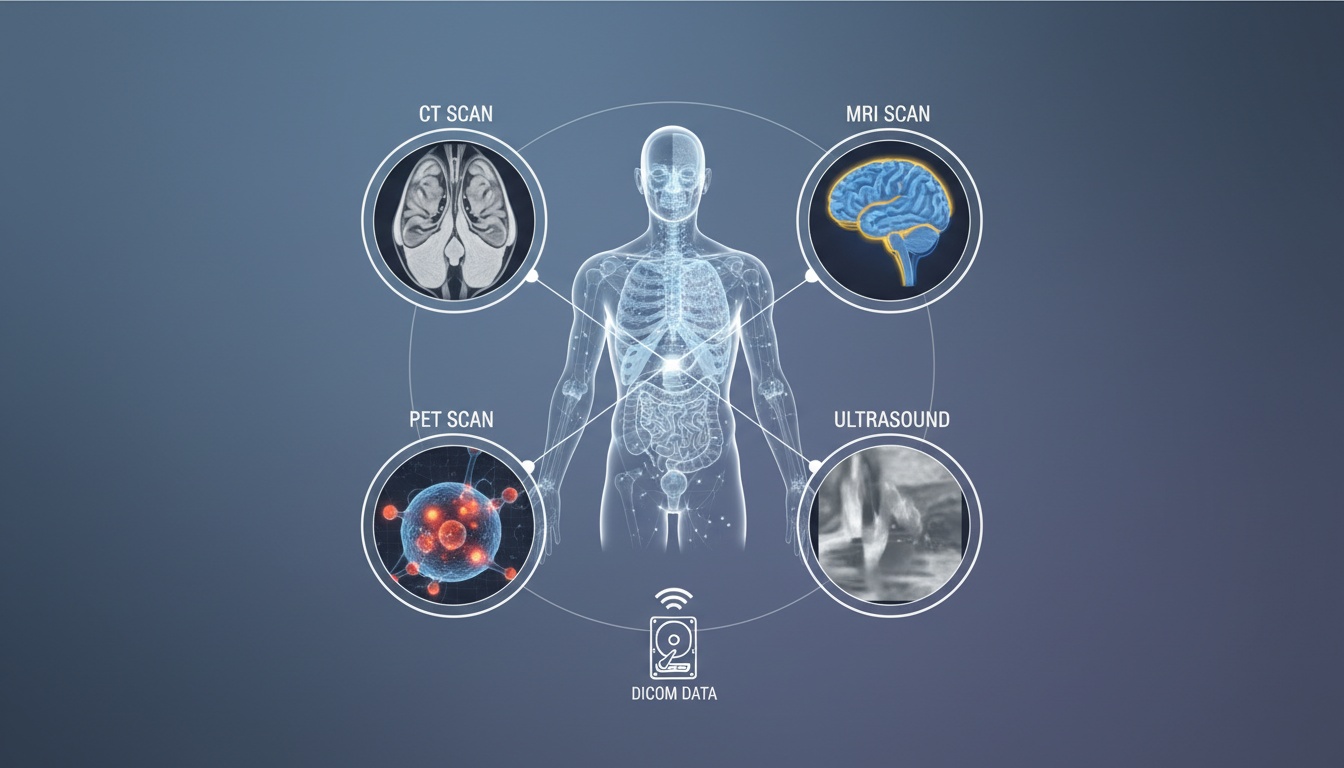
Medical imaging is not about looking at one picture anymore. These days, doctors need to look at a lot of pictures to figure out what is going on. They use imaging like CT scans to see the body's structure really clearly. They use MRI scans to see the tissues in the body. They use PET scans to see how the body's cells are working. They use ultrasound to see what is happening in the body in real time.
In areas like cancer treatment, heart problems, brain problems, and emergency care, being able to put all these Medical imaging pictures is really important. Doctors need to be able to combine imaging pictures from different sources to get an accurate idea of what is going on. It is not about getting really clear pictures from Medical imaging. It is about being able to combine all the Medical imaging pictures to get an understanding.
• Multimodal Imaging Makes Data More Complex In Clinical Workflows.
• The Infrastructure, Not The Technology Used To Get The Images Usually Decides How Efficient Diagnoses Are.
• Centralized Data Collection And Standardizing Metadata Are Crucial For Managing Studies
• Cloud-based Pacs Systems Allow For Scaling And Working Together Across Different Sites.
• Optimizing Performance, By Using Streaming And Distributed Computing Makes Interpretations Faster.
• We Must Build Rules And Guidelines Into The Infrastructure To Ensure Everything Is Compliant And Secure.
• A Good Enterprise Imaging Plan Relies More And More On Cloud-based Models.
Imaging studies are captured in outpatient centers, reviewed in tertiary hospitals, discussed in tumor boards across cities, and sometimes accessed remotely by subspecialists. The traditional assumption—that imaging workflows occur within a single physical radiology department—no longer reflects operational reality.
As multimodal imaging volumes expand, the limiting factor is no longer image acquisition quality. It is infrastructure. The ability to ingest, normalize, store, retrieve, and visualize diverse imaging datasets in a synchronized and scalable manner has become central to clinical efficiency. Without a robust backend architecture, multimodal workflows fragment, collaboration slows, and diagnostic timelines extend.
This means that Picture Archiving and Communication Systems or PACS for short is very important. PACS is not a place to store medical images. It is a part of the system that helps doctors work together and share information. In hospitals, especially those that use cloud computing, PACS is the central system that makes everything work together. Healthcare relies on PACS to help doctors work with images from different machines and different places. PACS is essential, for making sure that doctors can see all the images they need to make good decisions.
In practice, multimodal imaging is not an abstract concept. It is a daily operational necessity.
Consider an oncology tumor board. They look at a patients PET-CT scan to see where the cancer is active. They look at an MRI to see the exact shape of the tumor. The doctors, including radiologists, oncologists and surgeons need to look at these pictures to figure out the best way to treat the patient. If they have to look at the pictures or move them from one computer to another it takes a long time and they might make mistakes.
In heart doctor offices a patient might get a CT scan to look at the arteries and an echocardiogram to see how the heart is working. The doctors need to look at both of these pictures to make a decision about what to do next. If they can look at both pictures at the time on the same computer they can make a decision faster.
When someone has a stroke the doctors need to act. They need to look at a CT scan to see if there is any bleeding in the brain and they need to look at an MRI to see if there is any damage to the brain tissue. If the doctors have to wait to look at these pictures it can be very bad for the patient. Delays in getting the pictures are not just annoying they can be dangerous.
When surgeons are planning to operate on bones and joints they need to look at pictures from an MRI and a CT scan. They need to be able to look at both pictures at the time to plan the best way to do the surgery. Multimodal imaging, like combining MRI and CT scans is very important for doctors to do their jobs well.
Across these examples, multimodal imaging introduces three operational requirements:
1. Centralized Data Availability– All Studies Accessible Within A Unified System
2. Cross-modality Visualization– Synchronized Comparison And Fusion
3. Scalable Storage And Retrieval Performance– No Degradation As Study Volumes Grow
When hospitals don't have the equipment work gets messy. Different machines store images in places. Doctors have to log in times or use specific computers to see them. They even have to send images to work together which isn't secure or fast.
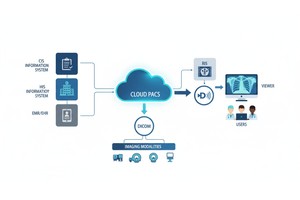
Modern PACS systems, those, in the cloud change everything. They go from storing images to helping doctors work together smoothly. They take in images from machines organize the information and let doctors access it easily from anywhere.
As medical imaging gets more complicated having good equipment really matters. If the equipment isn't good enough it causes problems. Slows down doctors. A good PACS system makes it easier for doctors to work together and make diagnoses.
The way PACS works is important. PACS helps doctors share images and information easily. PACS makes it simple to get what you need.
Imaging environments are really complicated because they have a lot of things going on at the same time. You have an amount of data, different types of imaging like CT and MRI varying metadata and people from different departments trying to access it. The good thing about using imaging is that it helps doctors diagnose problems more accurately. The system that supports all of this is often not given enough attention.
At the foundational level, every modality—CT, MRI, PET, ultrasound, echocardiography—produces DICOM-compliant datasets. Just following the rules is not enough to make sure everything works smoothly. The studies need to be brought in organized labeled, adjusted and directed within one main system. Without structured ingestion workflows, metadata inconsistencies can compromise search features and synchronizations.
Modern multimodal environments require automated routing rules that:
• Accept Studies From Multiple Modality Vendors
• Normalize Dicom Metadata Fields
• Assign Consistent Patient And Study Identifiers
• Prevent Duplication Across Distributed Networks
A cloud-based system makes it easier to manage things. Of sending images through local computers and special hardware the cloud-based system sends studies to a central storage place where it can handle a lot of information at the same time. This means that all the different sites will have the settings and the cloud-based system will make sure that all the imaging networks work together smoothly.
Importantly using a central cloud-based system gets rid of the problems that often happen with old systems where each department has its own storage system. The cloud-based system makes sure that all the departments are connected and use the rules. This helps to simplify the cloud-based architecture and makes it easier to use the cloud-based system for all the imaging networks.
Multimodal imaging significantly increases data size. For example PET-CT fusion studies, multiphase MRI sequences and resolution 3D reconstructions create a lot of data. We need to be able to look at this multimodal imaging data whenever we want without slowing down the system. The multimodal imaging data has to be easy to access so we can use it when we need to.
Cloud-native storage enables:
• Elastic Scalability As Imaging Volume Grows
• Tiered Storage Strategies (hot Vs Archive Layers)
• Redundant Geographic Replication
• High Durability Against Hardware Failure
Unlike PACS systems that need expensive hardware upgrades every now and then a cloud system can easily adjust its capacity without disrupting work.
This flexibility is really important, in hospitals where the number of images can go up and down at different times of the year or when they add new services.
The system should also be able to move images to cheaper storage while still being able to get them quickly when doctors need them.
Infrastructure does not just stop at storing things. How fast you can get to what you need is what really matters. This is what decides if your workflow is going to be efficient or not.
Modern workplaces use web browsers to look at things. They do not need any special programs on the computer. Doctors can look at all the studies they need from anywhere. They do not have to install any special software to do it. This is really helpful, in:
• Multi-site Hospital Systems
• Teleradiology Networks
• Remote Tumor Boards
• Cross-border Consultations
A good Cloud PACS system lets doctors see images in real time. They do not have to download files. This means they can look at a lot of information quickly.
The system shows the important parts of the image first. This makes it easier for doctors to use even when the information is complicated.
This way of accessing images changes the way PACS works. Cloud PACS is not just for one department. It is, for the hospital. Cloud PACS is the backbone of the hospitals imaging system.
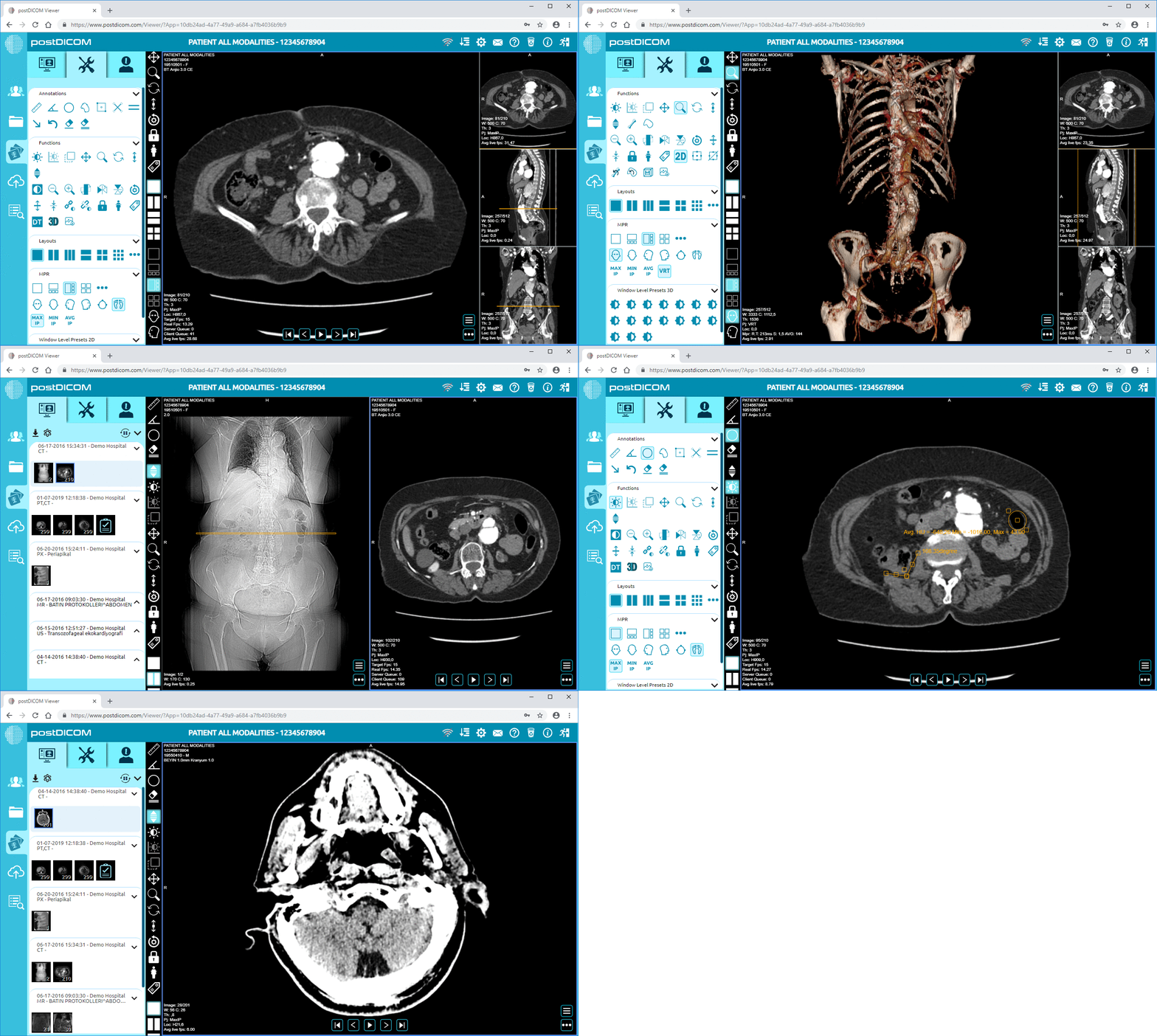
 - Created by PostDICOM.jpg)
When multimodal imaging infrastructure is cloud-enabled, operational benefits extend beyond storage centralization.
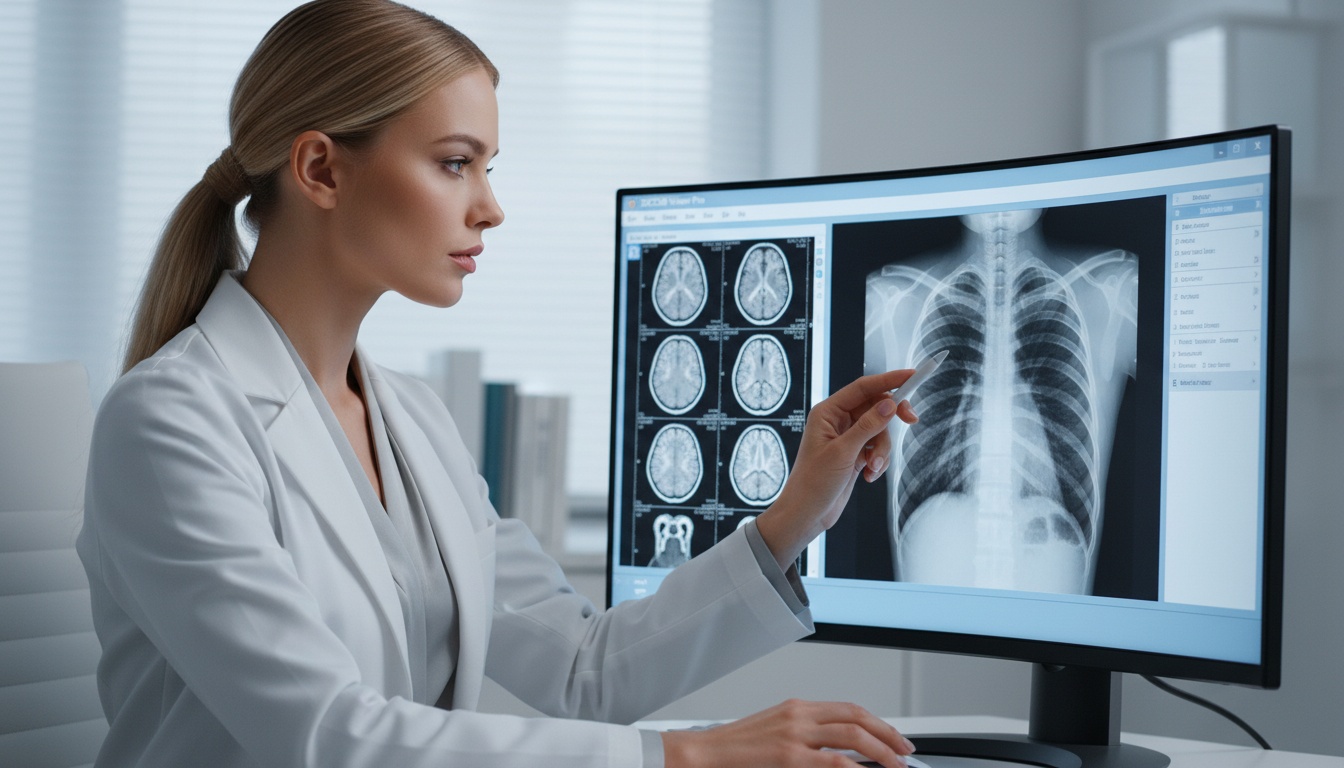
Unified study management allows clinicians to retrieve all relevant modalities through a single interface. Cross-modality visualization tools enable synchronized scrolling, fusion overlays, and side-by-side comparison—critical for oncology staging and cardiovascular planning.
Cloud-based medical imaging systems also make it easy to use intelligence tools. Of manually exporting data images can be sent to machine learning services through automated workflows. This helps with tasks like measuring, detecting abnormalities or analyzing data. It makes things run smoothly while still keeping track of everything.
From a standpoint cloud-based systems reduce the need for on-site hardware maintenance. They also lower the risk of downtime. Make it easier for different facilities to access images. The IT team can manage everything from one place, which makes it faster to update and secure the system.
For healthcare organizations that are growing or adding imaging centers a cloud-based medical imaging solution is a good option. It eliminates the need to buy and set up hardware at each site. New imaging equipment can be added through configuration rather than a big installation.
In imaging efficiency is not just about loading images quickly. It is, about making sure that clinical decision-making is coordinated across the diagnostic ecosystem. Cloud infrastructure makes this coordination possible on a scale.
As we use kinds of imaging like PET-CT and MRI it is very important that the systems we use to store and look at these images are stable and work well. When many doctors are looking at these images at the time it can be really hard on the systems.
We have datasets from PET-CT and lots of MRI sequences and when we make 3D pictures from them it can be too much for the old systems.
Using the cloud to store and look at these images is a way to solve this problem. Of having all the information in one place we can use many computers and storage spaces that can be added to as needed. This means that when we have a lot of images to look at the system will still work quickly.
We also have streaming technology that helps with this. Now doctors do not have to wait for the whole image to download before they can start looking at it. They can start looking away and the rest of the image will load in the background. This is very helpful, in emergency rooms where every second counts.
We also need to think about how our system will work when our organization gets bigger. When hospitals join together or partner with hospitals they need to be able to share information easily. If we have to buy hardware every time this happens it can be very expensive and complicated.. If we use the cloud new hospitals can just connect to the system we already have and it is easy and secure.
Data governance forms the third pillar of sustainable multimodal imaging infrastructure. Multimodal studies often contain sensitive patient information distributed across departments and external collaborators. Enterprise-ready systems must incorporate:
• Encryption At Rest And In Transit
• Role-based Access Controls
• Multi-factor Authentication
• Comprehensive Audit Logging
• Regulatory Compliance Alignment (hipaa, Gdpr, Regional Frameworks)
Without structured governance, the benefits of multimodal access can be offset by security risk. Modern Cloud PACS environments integrate governance policies directly into the architecture, ensuring that expanded accessibility does not compromise patient data protection.
Many healthcare institutions still operate legacy PACS systems designed for single-site radiology departments. While functional, these systems often struggle under multimodal, multi-location demands.
Below is a simplified operational comparison:
| Feature | Legacy PACS | Cloud PACS |
| Scalability | Hardware-limited | Elastic, on-demand scaling |
| Multi-site access | Complex VPN setups | Secure browser-based access |
| Storage expansion | Capital upgrades required | Dynamic cloud allocation |
| Maintenance | Local IT dependent | Centralized management |
| AI integration | Often limited | API-enabled integration |
| Disaster recovery | On-site redundancy | Geographic redundancy |
In multimodal imaging environments, where diverse datasets must be accessible across departments and facilities, cloud-based systems provide operational resilience that legacy architectures struggle to match.
The shift is not about new technology. It is about how the systems we use to take pictures and do imaging are changing to help big companies give better care to people. The imaging systems are getting better, at helping companies that give care to a lot of people.
Multimodal imaging will continue to evolve as diagnostic medicine becomes increasingly data-intensive. Fusion techniques will become more sophisticated. AI-assisted interpretation will expand. Cross-institution collaboration will intensify. Imaging volumes will grow.
However what makes these advancements possible is not the technology itself. It is the system that brings them all together.
Healthcare organizations that invest in scalable, cloud-enabled imaging ecosystems position themselves to support diagnostic innovation without operational bottlenecks. Those that rely on fragmented or hardware-constrained systems may encounter increasing friction as multimodal complexity accelerates.
Cloud-based PACS platforms transform imaging from a departmental archive into a coordinated enterprise system. In this way they create a foundation, for diagnostic workflows to operate efficiently. These workflows involve types of imaging and need to be secure and able to handle a large volume of data.
Cloud PACS improves multimodal imaging workflows by centralizing image ingestion, storage, and access across all modalities within a single scalable environment. Instead of storing CT, MRI, PET, and ultrasound studies in separate systems, cloud-based infrastructure unifies them under standardized DICOM routing and metadata normalization processes. This allows clinicians to compare modalities side by side, perform fusion visualization, and retrieve studies without navigating multiple repositories. The result is reduced workflow fragmentation and faster diagnostic coordination across departments and facilities.
Yes. Modern Cloud PACS environments are typically designed with API-enabled architectures that allow integration with AI analysis platforms. Multimodal datasets can be securely routed through machine learning engines for automated lesion detection, quantitative measurement, or predictive analytics. Because the infrastructure is centralized, AI tools can access harmonized imaging data across modalities without manual export processes. This supports scalable AI deployment while preserving audit trails and governance controls.
Cloud PACS offers elastic compute scaling, progressive image streaming, and distributed storage redundancy that legacy hardware-bound systems often lack. In multimodal imaging, where large fusion datasets are common, streaming technology allows clinicians to begin reviewing images immediately rather than waiting for full downloads. Cloud systems also dynamically allocate resources during peak demand, maintaining consistent performance even as imaging volumes grow. These capabilities reduce latency and improve operational stability in multi-site healthcare networks.
Enterprise-grade Cloud PACS platforms incorporate encryption at rest and in transit, role-based access controls, multi-factor authentication, and comprehensive audit logging. These governance measures ensure that expanded access across departments and facilities does not compromise patient data protection. Additionally, cloud deployments often include geographic redundancy and disaster recovery mechanisms that enhance system resilience compared to single-site hardware installations. When properly implemented, cloud-based imaging infrastructure meets or exceeds regulatory compliance standards required in modern healthcare environments.
Cloud PACS supports multi-site networks by eliminating the need for separate hardware deployments at each facility. New imaging centers can securely connect to the centralized environment without replicating physical infrastructure. This enables consistent imaging access policies, unified study management, and simplified administrative oversight. For organizations undergoing expansion or consolidation, centralized cloud deployment reduces integration complexity while maintaining synchronized multimodal workflows across the network.
|
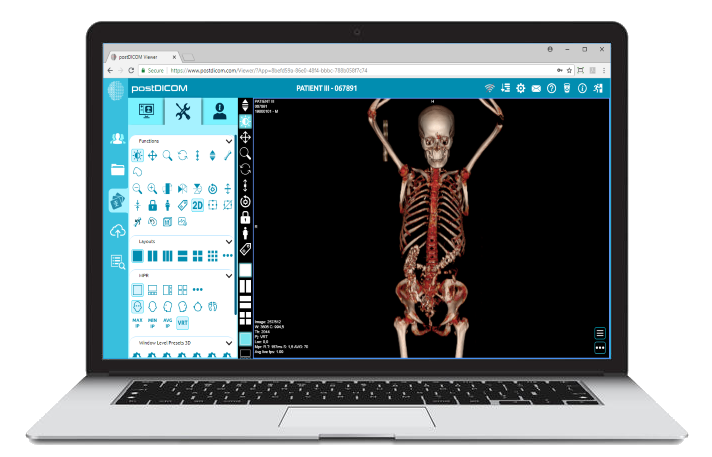
Cloud PACS and Online DICOM ViewerUpload DICOM images and clinical documents to PostDICOM servers. Store, view, collaborate, and share your medical imaging files. |